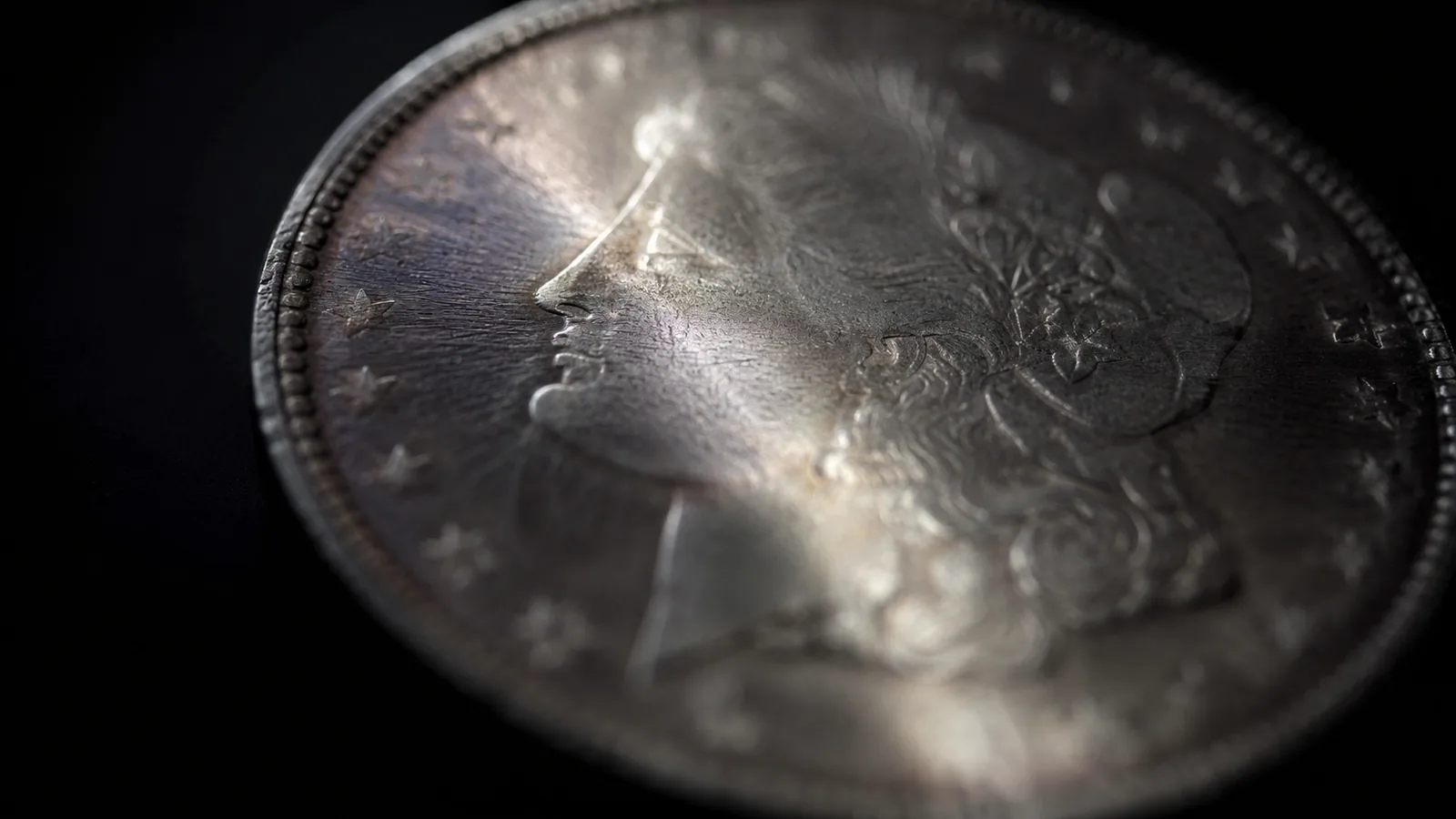
Peace dollars (1921–1935) are a complete-set-sized series — two dozen date/mint combinations — which makes them the most finishable classic dollar set. But they grade differently than Morgans, and buyers who bring Morgan instincts overpay in predictable ways.
We don't print price tables that rot. Every price claim on this page is a shape — where the jumps live — and the links below open live and sold listings so you're always pricing off today's market, not last year's guide.
What's different about grading Peace dollars
- Strike softness is endemic. Many issues — especially early-1920s branch mints — come weakly struck, with mushy hair detail over the ear. Weak strike is not wear: a fully lustrous, softly struck coin is still mint state. Learning that distinction is the series' entry exam.
- Luster is the tell. With detail unreliable, unbroken cartwheel luster is how you separate AU from MS. Rotate the coin; friction shows as dull patches on the cheek and high hair.
- Marks hide differently. The broad, open fields show contact plainly — the reverse eagle's shoulder and the obverse fields are the grade-deciding zones.
The value map
- Common dates (1922–1925 Philadelphia): abundant through MS64; the 64→65 step is meaningful and 65→66 steepens hard. The value grade for type is a clean MS64.
- 1921 — the high relief year: first-year issue in high relief, one year only, perpetually in demand. Weakly struck at the centers almost by design; priced on its own curve at every grade.
- 1928 — the low-mintage key: the series' famous key date, valuable in every grade and a counterfeit/altered-date target — buy certified, full stop.
- Better semi-keys (1924-S, 1925-S, 1927-S, 1934-S): the sleeper zone. Several are common circulated but genuinely scarce in gem — the 1925-S and 1934-S in MS65+ are condition rarities. This is where knowledgeable Peace buyers concentrate.
The series' honest value grade
For most dates: certified MS64 with strong luster for the issue. Gem premiums are steep and populations thin, while 64s deliver most of the look. Exception: if you're buying the 1934-S or another condition rarity, you're buying the scarcity itself — different game, certified only.
Buying rules for the series
- Judge strike against the issue's norm, not against a Philadelphia 1922. Demand the strike quality the date actually comes with, and don't pay full-strike money for typical softness.
- Certified for the 1921, the 1928, and anything MS65-and-up. Raw is acceptable only on cheap circulated commons.
- Toned Peace dollars run from spectacular to problematic — the series' surfaces tone unevenly; see our toning guide before paying color premiums.
Comp the series where money actually changes hands
As an eBay Partner, I may be compensated if you make a purchase.
→Sold: PCGS MS64 Peace dollars →Sold: PCGS MS65 Peace dollars →Live: certified 1928 Peace dollars →Live: certified 1921 high relief Peace dollarsWatch the 64→65 spread by date — it's mild on commons and dramatic on the S-mint condition rarities.
The Peace dollar rewards patience and luster literacy. Bring both and it's the best value neighborhood in classic dollars; bring neither and every softly struck slider looks uncirculated.