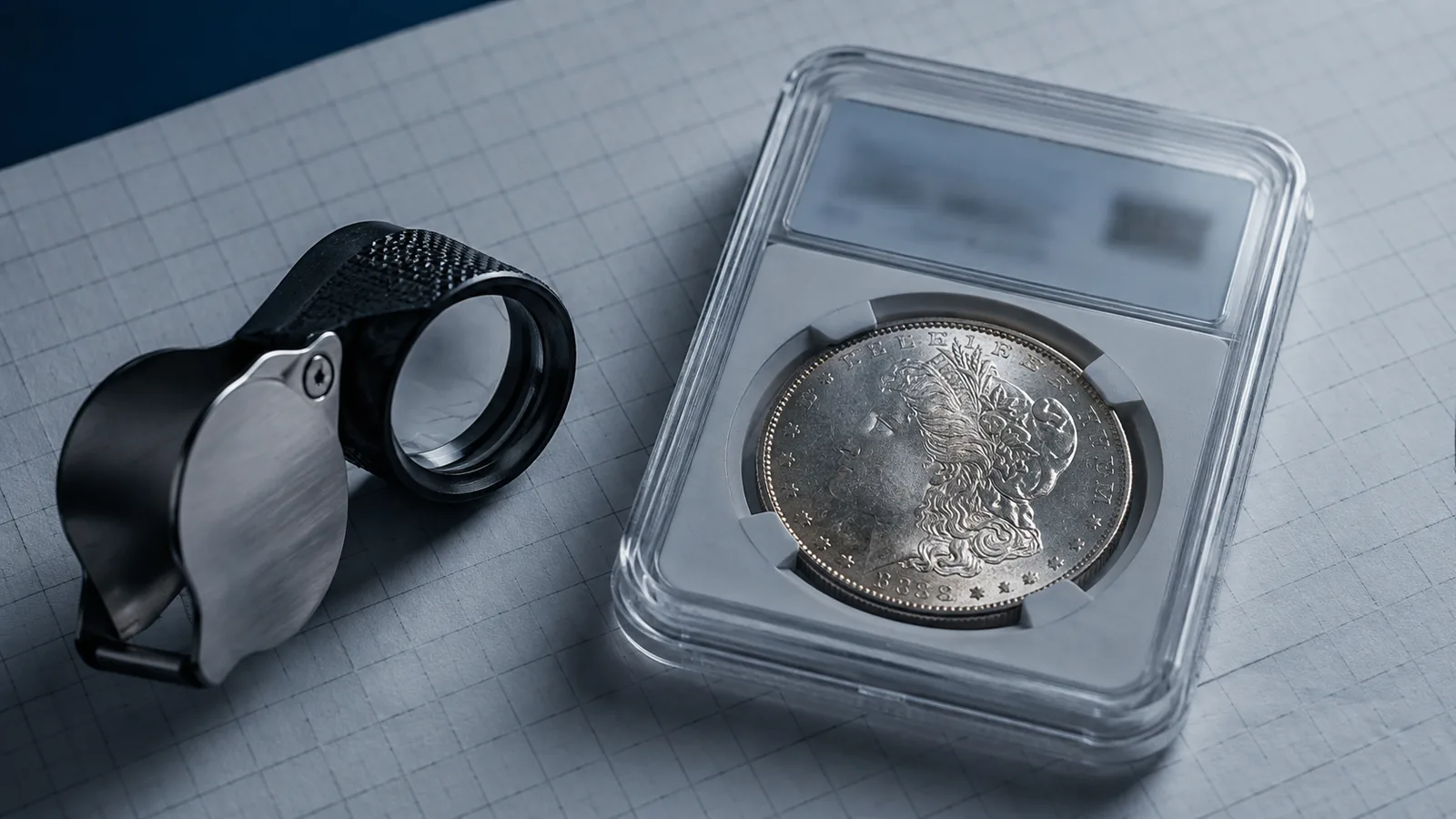
In 1949, Dr. William Sheldon — a numismatist studying early American large cents — published a scale from 1 to 70 built on a pricing idea: a cent grading 70 should be worth seventy times a cent grading 1. As a price formula it barely outlived its printing. As a vocabulary, it conquered everything: when PCGS launched third-party encapsulation in 1986, it adopted Sheldon's numbers, NGC followed, and the 70-point scale became the operating system of the entire market.
The scale, band by band
| Band | Label | What it means in hand |
|---|---|---|
| 1–3 | Poor / Fair / About Good | Identifiable, barely; heavy honest wear |
| 4–6 | Good (G) | Major design visible, rims mostly full, details flat |
| 8–10 | Very Good (VG) | Design clear, major details beginning to show |
| 12–15 | Fine (F) | Moderate even wear; lettering and devices sharp-ish |
| 20–35 | Very Fine (VF) | Light-to-moderate wear on high points only |
| 40–45 | Extremely Fine (XF/EF) | Slight wear, most detail crisp, traces of luster |
| 50–58 | About Uncirculated (AU) | Trace friction on the highest points; luster largely intact |
| 60–70 | Mint State (MS) | No wear at all — the band where marks, luster, strike and eye appeal take over |
Two structural quirks worth internalizing: the scale is not linear (the distance between MS64 and MS65 can be worth more than the distance between VG8 and XF45), and the numbers skip — graders use established steps (e.g., VF20, 25, 30, 35), not every integer.
Inside the mint state band
From 60 to 70, wear is off the table by definition — every point is awarded on four factors:
- Marks: number, size, and location of contact marks (a cheek mark costs more than a field mark).
- Luster: the original cartwheel sheen — boomy, satiny, or impaired.
- Strike: how completely the design filled the dies.
- Eye appeal: the honest wildcard that separates two technically equal coins.
MS63 means "uncirculated with noticeable marks," MS65 means "gem — clean and attractive," and the price staircase between them is where most of the market's money changes hands (see it applied in the Morgan grade guide).
Proofs use the same numbers
PR/PF grades (PR65, PR70DCAM) describe proofs — a method of manufacture, not a grade level. A proof can be impaired to PR58 by mishandling; a business strike can never become a proof. The number means the same; the prefix tells you what kind of coin earned it.
Why a 1949 pricing formula still runs a 2026 market
Because the market needed a shared language more than a perfect one. Third-party grading works when a stranger in another country reads "MS65" and knows what surfaces to expect — and seventy familiar numbers, refined by decades of published standards and millions of graded coins, deliver exactly that. The scale's arbitrary origin is trivia; its universal adoption is the entire infrastructure of sight-unseen trading.
Watch the scale price coins in real time
As an eBay Partner, I may be compensated if you make a purchase.
→Sold: same series across grades — Morgan VF →Sold: Morgan MS63 →Sold: Morgan MS65Three searches, one date if you like — the non-linearity of the scale appears in the prices immediately.
Learn the bands, then learn your series' staircase. The number on the slab stops being jargon and starts being a price you can predict before the listing loads.